What is a Portable Solar Generator?
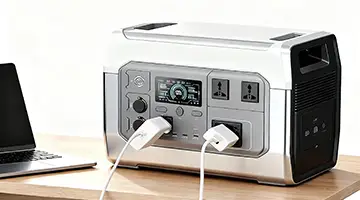
A portable solar generator is an integrated power system that combines solar panels, a battery storage unit, charge controller, and inverter in one compact, transportable package. Unlike traditional fuel-powered generators, it harnesses energy from the sun to provide clean, quiet electricity wherever you need it.
Think of it as your personal portable power station that runs on sunlight - perfect for camping trips, emergency backup power, or any situation where grid electricity isn't available.
Key Components Explained
The energy collectors that convert sunlight into direct current (DC) electricity. Portable systems typically use high-efficiency monocrystalline or polycrystalline panels.
The brain of the system that regulates voltage and current from the solar panels to the battery, preventing overcharging and optimizing performance.
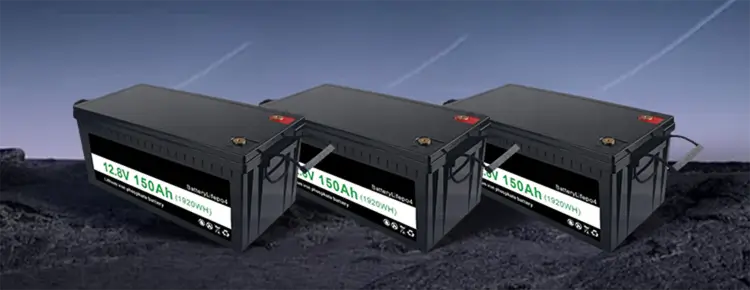
Stores the electricity generated by the solar panels. Modern systems use lithium-ion or LiFePO4 (lithium iron phosphate) batteries for better performance and longevity.
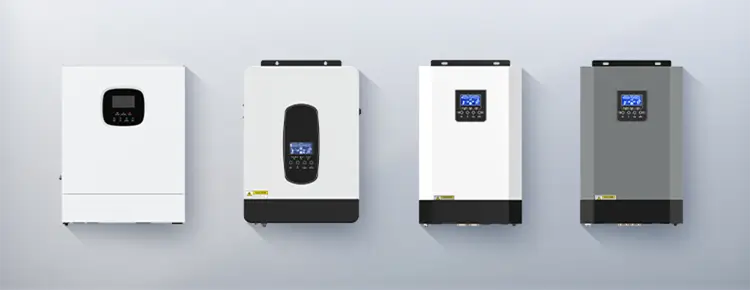
Converts the stored DC electricity into AC power that can run standard household appliances and electronic devices.
How Does a Portable Solar Generator Work?
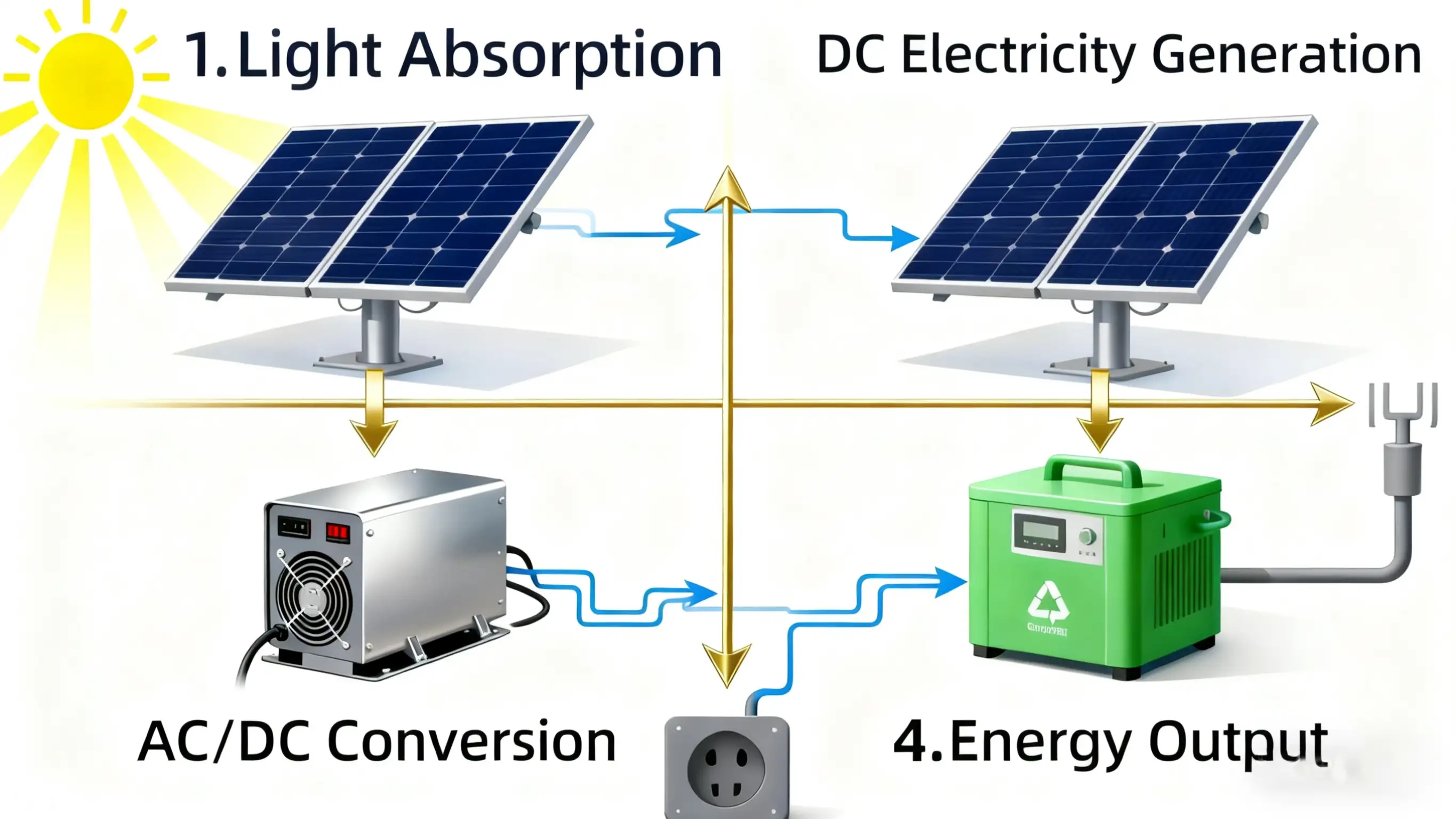
The operation of a portable solar generator follows a simple but efficient process:
- Energy Collection: Solar panels capture sunlight and convert it into direct current (DC) electricity.
- Voltage Regulation: The charge controller optimizes the power flow and protects the battery from overcharging.
- Energy Storage: Electricity is stored in the internal battery for later use.
- Power Conversion: When you need to power a device, the inverter converts the stored DC power into AC electricity.
- Device Operation: You can now plug in and run your electronic devices and appliances.
MPPT vs PWM Charge Controllers
Most quality portable solar generators use Maximum Power Point Tracking (MPPT) technology, which is 20-30% more efficient than older Pulse Width Modulation (PWM) controllers, especially in less-than-ideal lighting conditions.
Why Choose a Solar Generator Over Traditional Options?
Advantages of Portable Solar Generators
- Clean & Renewable: Zero emissions and runs on unlimited solar energy
- Quiet Operation: No noisy engine, perfect for camping and residential areas
- Low Maintenance: No oil changes, spark plugs, or fuel filters to replace
- Indoor Safe: No toxic fumes, can be used inside your home, RV, or tent
- Cost Effective: After initial investment, sunlight is free!
Solar vs Gas Generator Comparison
| Feature |
Solar Generator |
Gas Generator |
| Fuel Source |
Sunlight (free) |
Gasoline/Diesel (ongoing cost) |
| Noise Level |
Virtually silent |
Very loud (60-90 dB) |
| Emissions |
Zero |
High (CO2, CO, pollutants) |
| Indoor Use |
Yes, completely safe |
No, risk of carbon monoxide poisoning |
| Maintenance |
Minimal |
Regular maintenance required |
Note: While solar generators have many advantages, they do depend on sunlight availability and typically have lower power output compared to large gas generators. For high-power needs or extended cloudy periods, a hybrid approach might be best.
How to Choose the Right Portable Solar Generator
Selecting the perfect portable solar generator involves considering your specific power needs and usage scenarios.
Step 1: Determine Your Power Requirements
Calculate both your power (watts) and energy (watt-hours) needs:
For: Phones, laptops, LED lights, small fans
Capacity: 300-500Wh
Power: 300-500W
For: Mini fridge, CPAP, TV, coffee maker
Capacity: 500-1500Wh
Power: 500-1500W
For: Power tools, kitchen appliances, medical equipment
Capacity: 1500Wh+
Power: 1500W+
Step 2: Understand Key Specifications
Battery Capacity (Watt-hours)
This is your "gas tank" - how much total energy the generator can store. To calculate your needs, add up the watt-hours of all devices you plan to run.
Power Rating (Watts)
This determines what devices you can run simultaneously. Make sure the generator's wattage rating exceeds the total wattage of all running devices.
Battery Chemistry
LiFePO4 (Lithium Iron Phosphate) batteries offer 4-5x longer lifespan (2000-5000 cycles) compared to standard lithium-ion batteries, with enhanced safety and performance across temperature ranges.
Step 3: Consider Additional Features
- Port options: USB-C PD, AC outlets, 12V carport, wireless charging
- Charging methods: Solar, wall outlet, car charger
- Display & monitoring: LCD screens, mobile app connectivity
- Expandability: Ability to add extra battery units or solar panels
- Warranty & support: Look for at least 2-year warranty
Frequently Asked Questions
Can a portable solar generator power a refrigerator?
Yes, but you need to check both the starting watts (surge power) and running watts of your refrigerator. Most full-size refrigerators require 800-1200 starting watts and 150-200 running watts. Choose a solar generator with sufficient capacity and power output.
How long do portable solar generators last?
With proper care, the battery in a quality portable solar generator should last 5-10 years. LiFePO4 batteries typically last 2-3 times longer than standard lithium-ion batteries (2000-5000 cycles vs 500-1000 cycles).
Can I use a portable solar generator while it's charging?
Yes, most modern portable solar generators support pass-through charging, allowing you to use them while they're being charged by solar panels or wall outlets.
How long does it take to charge a portable solar generator?
Charging time depends on the battery capacity and solar panel wattage. With wall charging: 4-8 hours. With solar panels: 6-10 hours in ideal conditions. Some models like EcoFlow offer ultra-fast charging that can fully charge in 1-2 hours from a wall outlet.
Are portable solar generators worth the investment?
For most people who camp, experience power outages, or need portable power for work/hobbies, yes. While the initial cost is higher than gas generators, the long-term savings on fuel, maintenance, and the convenience of clean, quiet power make them an excellent value.